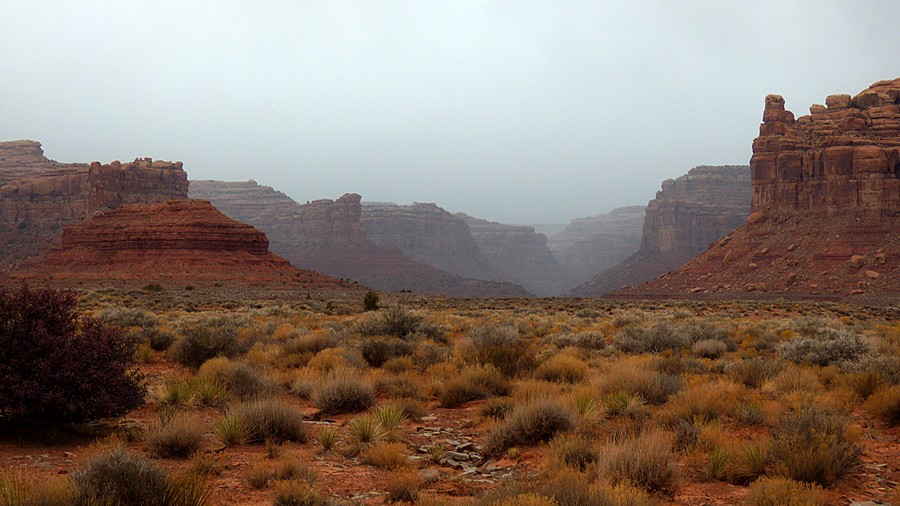
Tuesday,
23rd January_Tuesday, 31st January, 2018; Valley of the
Gods to Hovenweep, Utah.

C1658
“Come the long
Shadows of Evening”
(Sleeping
Ute Mtn., CO)
Oil Sketch on Centurian Oil Primed Panel
5” x 7”
In
the above Oil Sketch, Sleeping Ute Mountain is seen from the west from my camp
(see below) in Utah, while the mountain itself is in Colorado.
(Take Note: for
those of you who have signed up to be notified by email of new postings to this
blog, you have been receiving not just a notification, but an actual copy of
the new blog posting as the email. As
this does not show the images of the paintings in the best possible light, you
should click on the title of the latest blog posting at the top of the post,
and not the title of the painting itself; this will open up the actual blog
itself, and you may then enjoy the paintings at their best.)
Leaving Valley of the
Gods and proceeding up the Moki Dugway, for the second time in a few days, I
head out towards Muley Point, but a mile short I turn onto the track towards
Cedar Point instead, and have lunch.
Afterwards I continue on towards Natural Bridges, but at Snow Flat Road I
turn east for a couple miles to get a feel for the road to Moon House, a ruin I
was told about by a couple back in Comb Ridge eight days before. The dusting of snow of three days before in
Valley of the Gods, was three or four inches up here, and when I came to a
steep descent, decide I don’t like the thought of trying to get back up. I turn around; perhaps another time.
At Natural Bridges
National Monument, I fill my water bottles at the closed visitors center, and
then drive the loop, stopping at every layby and take photos as the opportunities
present themselves, including the three Natural Bridges of the Monument, and
the Bears Ears, not too far away. Natural
bridges are cut by running water, whereas arches are formed by frost and wind
action. I’m the only one in the
campground that night.
Blanding is 34 miles away and I stop into the
library, thinking I’ll accomplish all I need to that day, and get to Hovenweep
by dark; not even. I camp northwest of
town for the next two nights and spend Thursday and Friday in the library. I am foiled on Friday, as their Wi-Fi is not
working and so am unable to post to my blog, but I do get a couple posts prepared
and all set to go at the next opportunity. I get away and head for Hovenweep, but with
evening coming on I come across a good camp a couple hundred yards off the road
on a clifftop overlooking the valley of Montezuma Creek, and with a great view
of Sleeping Ute Mountain. I remain here touching
up a couple of paintings, and varnishing seven others on the Saturday, and
block in a new painting of Sleeping Ute Mountain, on Sunday, finishing it on
the Monday.
 |
| Little Ruin Canyon, Hovenweep, Utah. |
 |
| Tower Point with Sleeping Ute Mountain beyond. |
On
Tuesday, I finally make it to Hovenweep, only twenty some miles from my clifftop
campsite of the past few days. Hovenweep
is divided into several units, which straddle the Utah Colorado border. I
visited here in October 2013, and walked the main unit, in Utah, and also the
unit in Colorado which includes the Horseshoe and Hackberry ruins. This time I visit them all.
 |
| Hovenweep Castle. |
 |
| The Square Tower from the so called Castle. |
Towers
seem to be the popular architectural form taken by the Ancestral Puebloans in
the Hovenweep area, northwest of Sleeping Ute Mountain. Coming from the northwest through the canyon
of Montezuma Creek, as I did, and then climbing out onto Cajon Mesa, which
looks like a wide, rolling sagebrush plain, sloping up to the northeast, it is
surprising when you come across the canyons cutting into this landscape. It must have been even more surprising for
the first Europeans to come across the ancient ruins within these canyons.
 |
| The View towards Twin Towers. |
 |
| The Twin Towers. |
The
main unit of Hovenweep is in Utah, consisting of a series of buildings spaced
out along the rim of, or within, Little Ruin Canyon. A two mile circular walk takes you past these
ruins, many of which are the remains of towers, two or more stories high, hard
by the cliff edge, or in the canyon perched on large boulders. One of my favorite is called Eroded Boulder
House, but I call it the Hobbit House … it is built within a naturally eroded
boulder that form natural walls on three sides, as near as I can make out, and
the roof; constructed walls contain the remainder. If your time is limited, this is the unit to
see, and the visitor center (closed in Winter), and campground are here. Water for your water bottles is found here
all year around in the picnic area near the visitor’s center. I took this circular walk on the Tuesday
afternoon, as well as the Wednesday morning to get different lighting on the
buildings.
 |
| The
Eroded Boulder House, but I think it is really the Hobbit House. |
 |
| Twin Towers & the Hobbit House from the Canyon. |
The Pigments used in
the painting:
Imprimatura: W&N
Venetian Red & Rublev Ercolano Red;
Drawing: W&N Cobalt
Blue;
Pigments: W&N Cerulean,
Cobalt and Ultramarine Deep Blues, Cadmium Orange, Venetian Red & Permanent
Rose;