Tuesday, February 13, 2018

Natural Bridges to Hovenweep.

Tuesday, 23rd January_Tuesday, 31st January, 2018; Valley of the Gods to Hovenweep, Utah.


C1658
“Come the long Shadows of Evening”
(Sleeping Ute Mtn., CO)
Oil Sketch on Centurian Oil Primed Panel
5” x 7”


In the above Oil Sketch, Sleeping Ute Mountain is seen from the west from my camp (see below) in Utah, while the mountain itself is in Colorado.


(Take Note: for those of you who have signed up to be notified by email of new postings to this blog, you have been receiving not just a notification, but an actual copy of the new blog posting as the email.  As this does not show the images of the paintings in the best possible light, you should click on the title of the latest blog posting at the top of the post, and not the title of the painting itself; this will open up the actual blog itself, and you may then enjoy the paintings at their best.)


Leaving Valley of the Gods and proceeding up the Moki Dugway, for the second time in a few days, I head out towards Muley Point, but a mile short I turn onto the track towards Cedar Point instead, and have lunch.  Afterwards I continue on towards Natural Bridges, but at Snow Flat Road I turn east for a couple miles to get a feel for the road to Moon House, a ruin I was told about by a couple back in Comb Ridge eight days before.  The dusting of snow of three days before in Valley of the Gods, was three or four inches up here, and when I came to a steep descent, decide I don’t like the thought of trying to get back up.  I turn around; perhaps another time. 

At Natural Bridges National Monument, I fill my water bottles at the closed visitors center, and then drive the loop, stopping at every layby and take photos as the opportunities present themselves, including the three Natural Bridges of the Monument, and the Bears Ears, not too far away.  Natural bridges are cut by running water, whereas arches are formed by frost and wind action.  I’m the only one in the campground that night.

Blanding is 34 miles away and I stop into the library, thinking I’ll accomplish all I need to that day, and get to Hovenweep by dark; not even.  I camp northwest of town for the next two nights and spend Thursday and Friday in the library.  I am foiled on Friday, as their Wi-Fi is not working and so am unable to post to my blog, but I do get a couple posts prepared and all set to go at the next opportunity.  I get away and head for Hovenweep, but with evening coming on I come across a good camp a couple hundred yards off the road on a clifftop overlooking the valley of Montezuma Creek, and with a great view of Sleeping Ute Mountain.  I remain here touching up a couple of paintings, and varnishing seven others on the Saturday, and block in a new painting of Sleeping Ute Mountain, on Sunday, finishing it on the Monday. 


Little Ruin Canyon, Hovenweep, Utah.

Tower Point with Sleeping Ute Mountain beyond.

On Tuesday, I finally make it to Hovenweep, only twenty some miles from my clifftop campsite of the past few days.  Hovenweep is divided into several units, which straddle the Utah Colorado border.   I visited here in October 2013, and walked the main unit, in Utah, and also the unit in Colorado which includes the Horseshoe and Hackberry ruins.  This time I visit them all.


Hovenweep Castle.

The Square Tower from the so called Castle.

Towers seem to be the popular architectural form taken by the Ancestral Puebloans in the Hovenweep area, northwest of Sleeping Ute Mountain.  Coming from the northwest through the canyon of Montezuma Creek, as I did, and then climbing out onto Cajon Mesa, which looks like a wide, rolling sagebrush plain, sloping up to the northeast, it is surprising when you come across the canyons cutting into this landscape.  It must have been even more surprising for the first Europeans to come across the ancient ruins within these canyons.


The View towards Twin Towers.

The Twin Towers.

The main unit of Hovenweep is in Utah, consisting of a series of buildings spaced out along the rim of, or within, Little Ruin Canyon.  A two mile circular walk takes you past these ruins, many of which are the remains of towers, two or more stories high, hard by the cliff edge, or in the canyon perched on large boulders.  One of my favorite is called Eroded Boulder House, but I call it the Hobbit House … it is built within a naturally eroded boulder that form natural walls on three sides, as near as I can make out, and the roof; constructed walls contain the remainder.  If your time is limited, this is the unit to see, and the visitor center (closed in Winter), and campground are here.  Water for your water bottles is found here all year around in the picnic area near the visitor’s center.  I took this circular walk on the Tuesday afternoon, as well as the Wednesday morning to get different lighting on the buildings.


The Eroded Boulder House,
but I think it is really the Hobbit House.

Twin Towers & the Hobbit House from the Canyon.


The Pigments used in the painting:

Imprimatura: W&N Venetian Red & Rublev Ercolano Red;

Drawing: W&N Cobalt Blue;

Pigments: W&N Cerulean, Cobalt and Ultramarine Deep Blues, Cadmium Orange, Venetian Red & Permanent Rose;

Rublev: Ercolano Red, Purple Ochre, Blue Ridge Yellow Ochre, Orange Molybdate & Lead White #2.

Saturday, February 10, 2018

Photo Miscellany from Canyonlands National Park, Part 2.

A few weeks ago I did not have time to add some photographs for two or three of my blog postings, so here is the second set from my travels from Island in the Sky to the Needles, Canyonlands National Park.


North & South Six-shooter Buttes, 
on the way to the Needles District, 
Canyonlands National Park; north is to the right.


Another view.


Wooden Shoe Arch.


Giant Mushrooms on the Cave Springs Road.


Old Cowboy Camp at Cave Springs.


Cave Springs; we are looking into the cave at the springs.


Pictographs on the ceiling at Cave Springs.


The Needles from the Cave Springs Trail.


At the end of the road.


Canyon on the trail to the Needles.


My Campsite outside the Park, in the Indian Creek Recreation Area.  
The light flat rock was my kitchen table.


Dark-eyed Oregon Junco.


On Indian Creek.


Day’s end near my campsite.


Thursday, February 8, 2018

Still in the Valley of the Gods.

Monday, 19th January_Tuesday, 23rd January, 2018; 
Valley of the Gods, near Mexican Hat, Utah.


C1656
“Evening Light on Setting Hen Butte & Rooster Rock”
(Utah)
Oil Sketch on Centurian Oil Primed Panel
4” x 6”


(Take Note: for those of you who have signed up to be notified by email of new postings to this blog, you have been receiving not just a notification, but an actual copy of the new blog posting as the email.  As this does not show the images of the paintings in the best possible light, you should click on the title of the latest blog posting at the top of the post, and not the title of the painting itself; this will open up the actual blog itself, and you may then enjoy the paintings at their best.)


I switched to a new campsite on Friday night, after photo-recon throughout the afternoon.  The late afternoon sun was warm, and the night warmer than many a day.  I’d been hearing weather reports for a couple of days, one from Flagstaff forecasting snow beginning at 6 AM, Saturday, the other from Salt Lake City for snow as well; Flagstaff lies roughly 200 miles to the southwest, and Salt Lake City about 300 to the north.  Saturday morning was overcast, still warmish, but by afternoon the wind was picking up, and out of the northwest.  During the day I went down to Mexican Hat to top up with petrol.  They assured me that we would get only a dusting, if that, but up on top of the mesa up Moki Dugway, there would be more, but not even a couple inches.  “We are in a bubble here; the weather goes around us.” One of the women said.

Mexican Hat.

Moki Dugway.

Monument Valley from near Muley Point.

Balancing Rock, or is it the Woman in a Tub?

I went up Moki Dugway, and then left to Muley Point, where I thought I might find a snug campsite tucked away among the Junipers & Pinion Pines somewhere up there, but the wind was quite strong and cold, so I decided to go back down to last night’s camp.  The wind had picked up down there as well, and too strong to use my little stove.  I thought that at sundown it might ease, and sure enough it did, and a cold supper was avoided.  The cloud also cleared away, but by Sunday morning it was windy with a vengeance, and there was a very light dusting  of snow, here and there in patches (had to look hard to see that it wasn’t frost), and up on the clifftops, a thousand to 1500 feet above there was more of a covering.  It was generally clear, and the Sun melted it all off, even though it remained cold.

I got on with my third painting, in Valley of the Gods.  Some kind of Hawk patrolled the wash below my camp, a flock of Scrub Jays chirped past, and another time Oregon Juncos worked their way through the few Junipers nearby.  Funny how you can go for a whole day seeing no birdlife, except the usual pair of Ravens that always seem present, and then the next day, seemingly loads a’ birds appear.


Passing shower;
overnight there was a dusting of snow,
but up on the plateau was about 4 inches.

Evening light after the shower.

Rooster Rock to the left,
Franklin Butte, right.

I think the butte to right of center looks like
either a Llama or a happy oversized dog with its tail up,
and eager to please.

Ice in the wash.

Thankfully by sundown the wind dropped enough for me to cook supper under the Winter stars.  In the northwest Vega was setting, with Deneb soon to follow, while in the southeast, Orion, was lying on his back, and below his feet Lepus, the Hare, had cleared the horizon, and then Sirius, the brightest of Stars, popped into view above the mesa top … one minute nothing, and then ‘pop,’ there was Sirius.  After the cloud of yesterday and the snow flurries had passed away, the heavens were especially clear, and the Winter stars achingly bright.  What modern man has lost!  Seeing these myriad stars night after night, and becoming intimate with their ways was something we were all familiar with, once upon a time in the long ago.


The new snow up on Cedar Mesa;
Mossback Butte on the right.

Sippapu Bridge,
Natural Bridges National Monument.

The Bears Ears.

On the road to Blanding from Natural Bridges;
the Abajo Mountains in the distance.


The Pigments used in the painting:

Imprimatura: Rublev Ercolano Red;

Drawing: Rublev Ercolano Red;

Pigments: W&N Cerulean, Cobalt & Ultramarine Deep Blues, Cadmiums Yellow Pale and Orange, Venetian Red;

Rublev: Ercolano Red, Purple Ochre, Blue Ridge Yellow Ochre, Orange Molybdate, Lead White #2.

Wednesday, February 7, 2018

Photo Miscellany from Island in the Sky to the Needles District, Canyonlands National Park, Part 1.

A few weeks ago I did not have time to add some photographs for two or three of my blog postings, so here are a few of from my travels from Island in the Sky to the Needles, Canyonlands National Park.

View west from the Neck, Island in the Sky.


Looking down on the Schafer Road, from the Neck.


Monitor & Merrimac Buttes, on the road down from Island in the Sky.


A closer view.


The Colorado River on the Potash Road, west of Moab.


Jughandle Arch on the Potash Road, west of Moab.


Moon rising over the La Sal Mountains, from my New Year’s campsite.


View from the Needles Overlook, towards the Needles.


Pines or firs in their own micro-climate, miles away from their nearest siblings.


Church Rock at the road junction that takes you to 
the Needles District of Canyonlands National Park.


Newspaper Rock, on the road to the Needles District.


Monday, February 5, 2018

In the Valley of the Gods.

Monday, 15th January_Tuesday, 19th January, 2018; Valley of the Gods, near Mexican Hat, Utah.

C1657
“Afternoon in the Valley of the Gods”
(Utah)
Oil Sketch on Pannelli Telati on fine cotton Panel
5” x 7”

(Take Note: for those of you who have signed up to be notified by email of new postings to this blog, you have been receiving not just a notification, but an actual copy of the new blog posting as the email.  As this does not show the images of the paintings in the best possible light, you should click on the title of the latest blog posting at the top of the post, and not the title of the painting itself; this will open up the actual blog itself, and you may then enjoy the paintings at their best.)


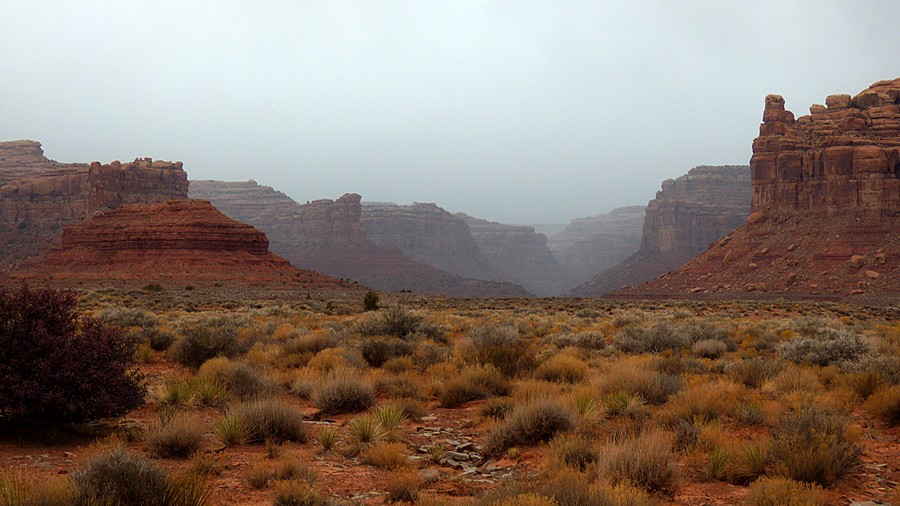
The first evening in the Valley of the Gods there was a very good Sunset.  Facing south I watched the glowing colours silhouette the buttes and mesas of Monument Valley, on the horizon some twenty miles away. The formations in the Valley of the Gods caught the rays of the evening Sun, as the blue shadows gradually climbed up their flanks to finally extinguish the last of the rosy light.  In the gloaming the odd headlight would appear on the distant highway coming from Mexican Hat, hidden from view in the folds of the Earth eleven miles distant.  There was even one that dropped down the continuous curves of the Moki Dugway, a preposterous road that climbs 1700 feet to the top of the mesa bordering the Valley, leading eventually to Natural Bridges National Monument.  Moki Dugway was built years ago to transport uranium ore down to a smelter (now gone), in Mexican Hat.  Looking at those Cliffs, one would not think a road could be built up them, but those pesky highwaymen can do astonishing things when they’ve a mind to.


First view of the Valley of the Gods,
from the Highway.

Monument Valley in silhouette
against the evening sky, from my campsite.

North from camp at evening.

Morning on the Setting Hen Butte & Rooster Rock …
I think the rooster is name more for its proximity to the hen.

Pre-dawn glow,
about 10 minutes before actual sunrise.

First light on the cliffs.
After getting on with some painting today (the days are still too short, but getting longer), I was preparing supper in the twilight, when a movement on the ground caught my eye, startling me.  I jumped, and the little beastie ran off, or I should say, hopped off, as it turned out to be a Kangaroo Rat.  He kept hopping about in my direction several times as if to saying, “come out to play, Steve;” bold little tyke.  I believe he was looking for morsels amongst the stony ground, as he did stop and seemed to find something every so often.  I did get a couple of slightly blurry photos … it was darkening by this time … I should have tried the flash, but I keep forgetting I have that option on this camera.  Supper prepared, I left him to his machinations, while I retired to the truck to eat as the evening was rapidly cooling.  No rat the next night … I wonder if they come out most nights, even at this time of the year?  Probably not.


Blurry shot of Kangaroo Rat.

Ice on the creek.

Further into the Valley.

The prow of Battleship Rock.


Battleship Rock …
it must’ve been named before
the modern cruise liners were built!

New Moon.


The Pigments used in the painting:

Imprimatura: Rublev Ercolano Red;

Drawing: Rublev Ercolano Red;

Pigments: W&N Cerulean, Cobalt & Ultramarine Deep Blues, Cadmiums Yellow Pale and Orange, Venetian Red;

Rublev: Ercolano Red, Purple Ochre, Blue Ridge Yellow Ochre, Orange Molybdate, Lead White #2.